
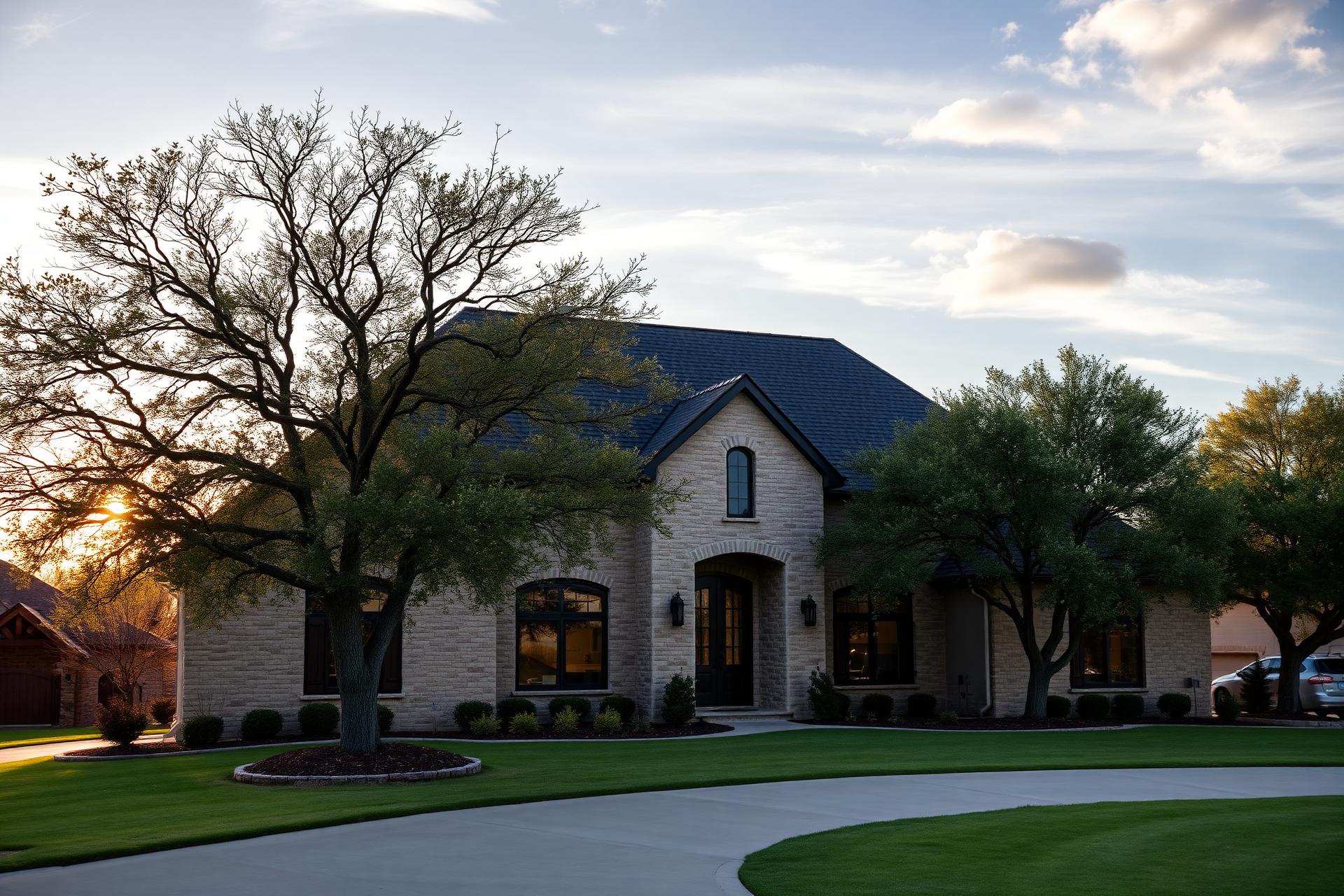
Roofing Company in Johnson City, TX
Johnson City is about 55 miles north of San Antonio on US 281, roughly an hour's drive. It's deep Hill Country. Ranch acreage, limestone homes, and standing-seam metal roofs are the norm rather than the exception, and that changes how we scope every job.
Blanco County, TX
Ranch acreage and rainwater catchment define the work
Johnson City roofing runs on Hill Country logic, not suburban logic. Properties are big. Many homes sit on twenty acres or more, tucked into cedar and live oak with a limestone facade and a wide, low roof profile. Standing-seam metal is the default material here, not an upgrade. Homeowners choose it for the fifty-year service life, the sun reflection, and the fire resistance in a landscape that gets dry. When we walk a property in Johnson City, we're usually walking a metal roof, and the questions we ask are metal-roof questions.
The other thing that changes everything out here is rainwater catchment. Plenty of Johnson City homes collect their household water from the roof itself. The roof isn't just weather protection, it's the collection surface for the tank in the yard. That means the roof material matters far more than it does on a typical San Antonio home. Certain coatings and finishes are compatible with potable collection and others aren't. Debris in the valleys turns into debris in the tank. When we scope a catchment roof, we scope it around what's actually going into your water, not just what's going onto your shingles.
Hill Country hail is intense and very localized. A storm can drop softball-size hail on one ranch and skip the next one over. On a standing-seam metal roof, hail damage is often cosmetic rather than functional, but cosmetic damage on a claim is still real damage that a carrier can pay on when it's documented right. On the older shingle roofs in town near the courthouse square, hail damage reads the way it reads anywhere else, with bruising on north and west slopes and lifted tabs at the edges. We document each roof by the material it actually is.
Cedar and live oak cover matters here too. Cedar drops fine debris that piles up in valleys and around penetrations. Live oak drops heavier limbs during Hill Country storms, and a snapped oak branch on a metal panel is a real puncture problem that needs immediate repair. We check every valley and every penetration on a Johnson City walk-through, because the tree situation up here is different from anything in Bexar County, and the roofs show it.
Roofing in Johnson City at street level
Johnson City sits in Blanco County.
Areas we work
- the courthouse square area
- the US 281 corridor
- the US 290 junction
- the surrounding ranch country
Hail exposure
Hill Country hail is severe and very localized. Johnson City can catch a serious storm while Blanco a few miles south sees almost nothing. On standing-seam metal we look for cosmetic denting on panel fields, on the ridge caps, and on any vent covers. On shingle roofs we look for bruising on north and west slopes. Either way we photograph slope by slope for the carrier.
Tree cover
Tree cover in Johnson City is cedar and live oak, mostly heavy on ranch properties. Cedar drops fine debris that piles up in valleys and around penetrations, especially problematic on catchment roofs. Live oak drops heavier limbs in storms and can puncture a metal panel outright. We check every valley and penetration on a walk-through and clean valleys as part of any inspection.
HOA material rules
HOA presence in Johnson City is essentially nonexistent. Most homes sit on ranch acreage with no material restrictions, which is why standing-seam metal is so common and why homeowners here choose it freely. A few small pockets have their own arrangements. On any home tied to rainwater catchment, the real rulebook is what's compatible with potable collection, and that matters more than any HOA guideline.
Typical roof age
Standing-seam metal in Johnson City often has decades of service life left. Many homes are still on their original roof from when the house was built, and that's normal here rather than concerning. Older shingle roofs near the courthouse square are on their second or third roof cycle. We assess each roof on its actual material and condition rather than a chronological age alone.
Why Johnson City homeowners call us
We work Hill Country metal roofs the way they're supposed to be worked. That means panel-by-panel inspection, honest calls on cosmetic versus functional damage, and real understanding of what a catchment roof needs beyond just staying dry.
- Standing-seam metal work as a core service, not an occasional job.
- Rainwater catchment awareness in material and cleaning choices.
- Panel repair versus full replacement calls based on actual condition.
- Valley cleaning and penetration checks against cedar and live oak debris.
- Blanco County work grouped so Johnson City visits stay predictable.
Everything we do, right here.
Metal Roofing
Standing seam and exposed-fastener metal roof installation in San Antonio & Hill Country. 40 to 60 year lifespan, energy efficient. Call (830) 443-3001.
Metal Roofing in Johnson CityRoof Replacement
Complete roof replacement in San Antonio & Hill Country. Owens Corning & GAF certified, tear-off and dry-in same day. Free estimate, call (830) 443-3001.
Roof Replacement in Johnson CityRoof Repair
Fast, honest roof repair in San Antonio & the Hill Country. Leaks, missing shingles, hail and wind damage, fixed right. Free inspection, call (830) 443-3001.
Roof Repair in Johnson CityProperty Insurance Claims
Storm damage documentation for roof insurance claims in San Antonio and the Hill Country. Free photo reports and measurements. Call (830) 443-3001 today.
Property Insurance Claims in Johnson CityRoof Inspection
Free roof inspections in San Antonio & Hill Country. Storm damage, pre-purchase, and annual check-ups with photo report. No pressure. Call (830) 443-3001.
Roof Inspection in Johnson CitySeamless Gutters
Seamless gutter installation in San Antonio & the Hill Country: custom-fit aluminum, formed on-site, installed same visit. (830) 443-3001.
Seamless Gutters in Johnson CityQuestions from Johnson City homeowners.
My roof feeds a rainwater tank. Does that change what you can put on it?
Yes, and we treat it as a real constraint rather than an afterthought. Certain metal coatings and finishes are compatible with potable rainwater collection and others aren't. Sealants and fasteners matter too. We'll walk through the specifics before recommending anything, because a wrong choice here contaminates your household water, not just your roof.
My metal roof got hail. It looks dented but it's not leaking. Is that a claim?
Often yes. Cosmetic damage on standing-seam metal is still damage worth documenting, and Hill Country hail hits hard enough to matter. We photograph the panel field, the ridge, and any vent covers separately, measure the affected areas, and write it up in plain language. What your insurer does with that record is up to them, but good documentation gets you a real conversation.
How often do you actually make it up to Johnson City?
Regularly, but on a scheduled basis rather than as one-offs. Blanco County work groups together, and we usually run Johnson City and Blanco on the same trip. For non-urgent quotes we schedule inside two weeks. For an active leak or storm damage we come out when it's genuinely urgent. That honesty keeps our pricing sensible for you.
Do you do standing-seam installs from scratch, or only repair?
Both. New standing-seam installs are a real part of our Hill Country work, especially on ranch homes where the owner wants the fifty-year service life. Repair work is more common because so many homes already have metal on them. Either way we scope it honestly against the property, and we'll walk you through the differences between panel profiles before you decide.
The cedar around my house drops constantly. Is that hurting my roof?
It's making it work harder. Cedar debris piles up in valleys and around penetrations, and on a catchment roof it ends up in your water tank. We include valley and penetration cleaning as part of any inspection we do here, and we'll show you what came off your roof so you can decide how often that needs to happen.
Local, Licensed, and Insured — serving Johnson City
Reviewed by Jose Puente, Civil Engineer (20+ yrs) & Owner.
Office: 10615 Perrin Beitel Rd, San Antonio, TX 78217.
Let's take a look at your Johnson City roof.
Free inspection, honest report, no pressure. Talk to Brenda 24/7 and we'll get on your schedule this week.